Nexcorio DataFeed v3 now streaming NSE & BSE F&O ticks, snapshots and option Greeks over one WebSocket.

See the specs

Product 03

FnO Algo Platform

A production engine for Indian index and stock derivatives: many strategies, one exchange socket, one risk veto and an audit trail you can reconcile. Java 21, multi-threaded, and monitored from your phone.

  • Virtual-thread engines
  • Pre-trade risk veto
  • Idempotent OMS
  • Backtest on live code
  • Heartbeat + siren
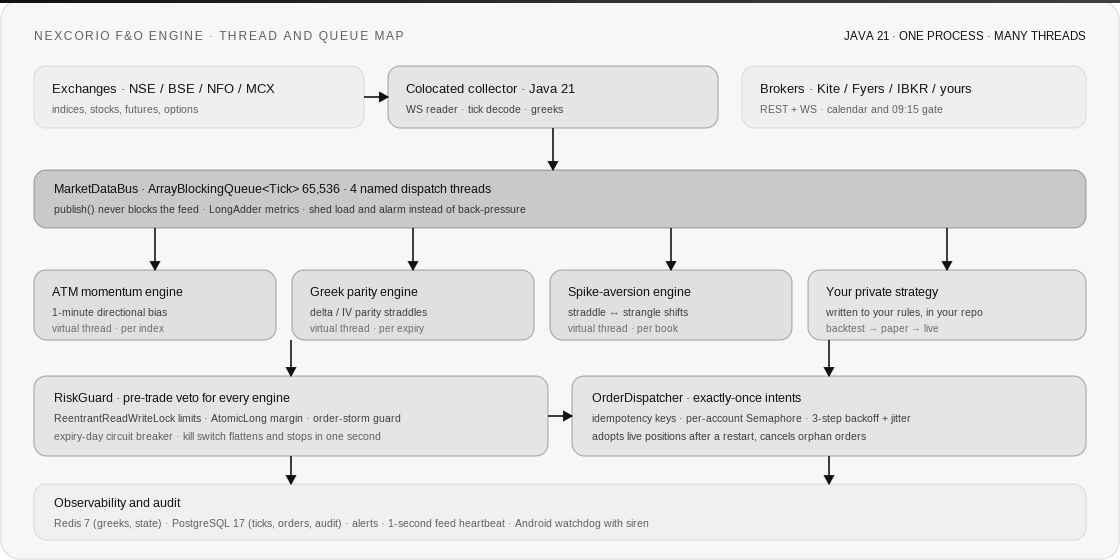
Architecture of the Nexcorio F&O engine: exchanges and brokers, a colocated Java collector, a bounded market data bus, parallel strategy engines, a risk guard, an idempotent order dispatcher and an observability layer.
Thread and queue map. One collector feeds a bounded bus; every strategy is its own thread; every order passes the risk guard; every event lands in PostgreSQL and on your phone.

Strategy library

Engines that ship with the platform

These are the strategies running in our reference deployment. Each one is a separate thread with its own parameters, lot limits and exit hours - and each can be switched off without touching the others.

Reference strategy set. Your own rules replace or join these; nothing is mandatory.
Engine What it watches Typical use
ATM momentumOne-minute directional bias on the at-the-money contract with premium confirmationIntraday index futures and options
Greek parityDelta and IV parity between call and put around the ATM strikeStraddle and strangle construction
Greek gapDislocation between theoretical and traded greeks on adjacent strikesRelative-value option trades
Greek-neutral rolling straddleContinuous delta neutrality while rolling the short straddlePremium selling with controlled direction bias
Price parity, IV basedPrice parity with an IV band, entering when the band is breachedVolatility mean reversion
Spike-aversion stranglePremium spikes and OI shifts that precede a squeezeAvoiding the wrong side of an expiry move
Straddle to strangle (and back)Premium decay versus risk, with automatic leg adjustmentExpiry-week premium capture
OI support-strengthOpen-interest walls and support or resistance strength by strikeDirectional bias from positioning
Dual IV parity with OI worthIV parity against the option's own worth, filtered by OI qualityStrike selection for straddles
Your strategyWhatever you write down - we implement it as an engine of its ownYour edge, automated

Four pillars

What makes it a platform and not a script

Risk rail one: pre-trade veto

Nothing reaches the exchange without passing the risk guard: per-strategy lot limits, mandate ceiling, margin accounting, a concurrent-order cap and a circuit breaker that trips on repeated broker errors. When it refuses a trade, it logs the reason and tells you - so a skipped entry is never a mystery.
MandateMarginOrder stormBreaker

Risk rail two: idempotent order path

Every intent carries an idempotency key, so a retry cannot become a duplicate position. Orders are rate-limited per broker account, retried with backoff and jitter, and reconciled after a restart - the engine adopts live positions and cancels orphan orders instead of guessing.

Exactly onceBackoffRestart safety

Backtest on the live code path

The clock is injected rather than simulated. Your strategy loops over historical ticks exactly as it loops over live ones, so the backtest exercises the same decisions, the same risk veto and the same order path. Slippage, brokerage, lot sizes and expiry-day behaviour are parameters, not afterthoughts.

5 years of ticksSlippageParameter sweeps

Telemetry you can act on

Per-thread metrics - queue depth, decisions per minute, vetoes, fills, rejects - plus a structured log of every signal with its reason. Daily P&L is attributed per strategy, and Telegram or e-mail alerts arrive within the second for anything that needs a human.

Per-thread metricsAttributionAlerts

Broker integration

Production experience with Zerodha Kite Connect, Fyers and Interactive Brokers; adapters for other REST and mobile-API brokers on request. One broker interface, many brokers - with the rate limits respected per account.

Multi-account, multi-client

One engine process can serve several accounts with separate mandates and order routers. A family office runs one platform, not five copies with five sets of bugs.

Paper mode

Every strategy can run in paper mode on live data - no capital at risk, identical decisions and logs - which is how we validate a new rule before it touches your money.

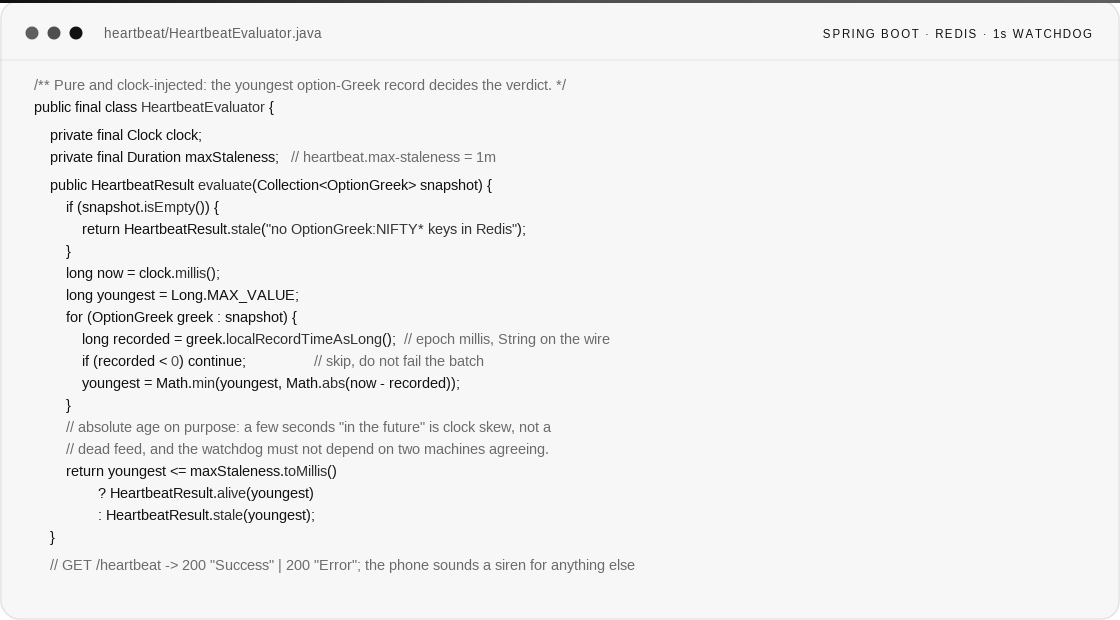
Java listing of the heartbeat evaluator service that reads option greeks from Redis and reports whether the feed is still being written, using an injected clock and an absolute staleness rule.
The watchdog. A one-second heartbeat service answers Success or Error; the phone app raises a siren within seconds of a silent feed.

Heartbeat and watchdog

The part that phones you when the market stops being honest about itself

The worst failure mode in algorithmic trading is not a rejected order - it is a feed that keeps returning the last known price. Everything looks normal, and decisions are made on stale data. We treat that as a first-class alarm.

  • A Spring Boot heartbeat service reads the option greeks in Redis every second and reports whether they are still being written.
  • An Android watchdog app polls that endpoint inside a configurable window - weekdays 09:15 to 15:15 by default - with a cache-busting request and a configurable interval from five seconds to an hour.
  • A siren, not a silent badge. On any answer other than Success the phone sounds an alarm on the alarm channel - audible in silent and do-not-disturb mode - and vibrates until it is acknowledged.
  • Survives reboots and task killers. The app restarts itself after a crash, resumes monitoring after a phone reboot, and a 15-minute watchdog alarm re-arms it on aggressive devices.
  • No false alarms for local problems. If the phone itself has no network, the check is skipped and reported as such, rather than sounding the siren for the wrong reason.

Deployment

Where your engine runs, and who keeps it alive

Colocated, in-region

Our reference deployment: a low-latency host in an Indian data centre, close to the exchange-facing path, with clock synchronisation, redundant connectivity and a monitored heartbeat. This is the deployment the latency numbers are measured on.

Your cloud tenant

Deployed into your own AWS, Azure or private-cloud account with infrastructure-as-code, secrets in your vault and logs in your account. We support it remotely and you hold the keys - common where data-residency rules apply.

On-premise, in your office

A self-contained install on your own hardware with a documented runbook, upgrade path and a handover session. For desks that want no external dependency on the order path at all.

Runbook

Start, stop, flatten, restart, adopt-position and rollover procedures, written so a non-developer can follow them at 09:20.

Monitoring

Health endpoint, per-thread metrics, queue depths, feed age and broker-error counters, with alert thresholds agreed up front.

Backups

PostgreSQL backups of orders, fills and the audit trail, with a tested restore procedure and a documented retention period.

Support

A market-hours support window, an escalation number and a named engineer - or a fully managed engagement where we hold the pager.

Licensing

Three ways to take the platform

Indicative pricing for a single-strategy, single-broker deployment in India. Multi-strategy, multi-account and fully managed engagements are quoted after the rules workshop.

Strategy build

From ₹ 2,75,000one-time · indicative

We automate one tested discretionary strategy on the platform.

  • Rules workshop, written spec and edge cases
  • Backtest on five years of ticks with slippage
  • Risk rails, alerts and a paper-trading window
  • Source code, tests and a handover session
Scope a build
Platform licence

On requestannual · per desk or per product

For proprietary desks, funds and platforms that want the engine in their own environment.

  • Engine, OMS, risk rails and reference strategies
  • On-premise or your-cloud deployment
  • Broker adapter development for your OMS
  • White-label option for client-facing products
Request platform pricing

Indicative prices in INR, exclusive of exchange fees, broker charges, cloud or colocation cost and applicable taxes. Every engagement starts with an NDA and a fixed-scope statement of work.

Platform questions

Asked by every serious buyer

Do I need to give Nexcorio access to my broker account?

For a managed deployment, yes - API credentials for the account the engine should trade. Those credentials live in a secrets store, are used only by your engine, and can be revoked by you at any time from your broker console. For an on-premise or your-cloud deployment, credentials never leave your environment and we support you without holding them.

What happens if the internet or the broker API goes down mid-trade?

The engine stops making new decisions, keeps its state, alerts you within the second, and retries the order path with backoff when connectivity returns. If positions are open and unmanaged beyond the configured window, the kill switch flattens and stops - a defined behaviour rather than a judgement call at 14:50.

Can I run my own strategies inside the platform?

Yes - that is the point of a platform licence. Your engineers implement against the same interfaces we use: signal evaluation, the risk veto, the order dispatcher and the telemetry hooks. We review the integration, run it in paper mode and then hand over the runbook. If you prefer, our engineers write it and hand you the source.

How is a strategy's performance reported, and what do you refuse to claim?

You get daily and monthly reports with fills, slippage, vetoes, profit and loss per strategy, and the drawdown. We do not publish headline return figures and we do not permit survivorship cherry-picking in any marketing material - including our own. Backtests always ship with the assumptions attached.

Does automation make my trading riskier?

It changes where the risk lives. Software can fail, so we treat failure as a design input: bounded queues, idempotent orders, a single risk veto, alerts and a kill switch. It does not remove market risk, and no automated system should be run without a loss limit you are willing to accept. We will say so plainly on the first call.

Start the conversation

Send us your strategy. Get a feasibility read within 24 hours.

Share your rules - an Excel sheet, a screenshot, even a screen recording of how you trade - and we come back with the build scope, expected latency, risk rails and a fixed quote. No obligation. NDA signed before we look at anything.

  • Fixed-scope proposal in one working day
  • Named engineer on the call, not a sales deck
  • Your strategy stays your IP - we build, you own